San Pietro in Bevagna is the beach village of the charming town of Manduria which is some 10 kilometers further up to the north. Manduria is a so far underrated gem, an ancient city with a lot of interesting sights to offer.


Manduria is a city and comune of Apulia, Italy, in the province of Taranto. With c. 32,000 inhabitants (2013), it is located 35 kilometres (22 mi) east of Taranto, and 14 kilometres (9 mi) north of the coast.
History
It was an important stronghold of the Messapii against Taras. Archidamus III, king of Sparta, fell beneath its walls in 338 BC, while leading the army of the latter (Manduria is also referred to as “Mandonion” in works by the Greek and Roman historian Plutarch). Manduria revolted against Hannibal, but was taken in 209 BC.
Pliny the Elder mentions Manduria in Natural History. He describes a well with a strangely constant water level. No matter how much water was taken out the water level never changed. The well also features an almond tree growing right from the middle of the well shaft. The well may still be seen today.
The town was destroyed by the Saracens in the 10th century. The inhabitants rebuilt on the site of the present town, which they renamed Casalnuovo. In 1700 they took back the ancient name of Manduria.


Main sights
The modern city is close to the site of the ancient Manduria, considerable remains of the defences of which can still be seen; they consisted of a double line of wall built of rectangular blocks of stone, without mortar, and with a broad ditch in front. Ancient tombs with gold ornaments were found in 1886.
The symbol of the city is a well with an almond tree growing from the center, which was mentioned by the Roman author Pliny the Elder in Naturalis Historia, a work published in the 1st century AD. The well (named Fonte Pliniano after Pliny the Elder ) can still be seen today exactly as it was described some 2,000 years ago, with the almond tree still rising out of the center. Other sights include:
- Chiesa Madre (or Collegiata) of medieval origin but renovated in the 16th century.
- Church of San Pietro Mandurino, probably a Hellenistic hall tomb adapted as a church in the 8th-9th century. Is opened to visits by the public only during certain celebrations.
- Church of the Holy Trinity (11th/12th centuries). It has a façade with three Renaissance portals and a rose window. The 15th-century bell tower is decorated by large masks of unknown origin.
- Church of SS. Rosario.
- Church of SS. Immacolata.
- Church of Santa Lucia (1540)
- Medieval Jewish Ghetto.
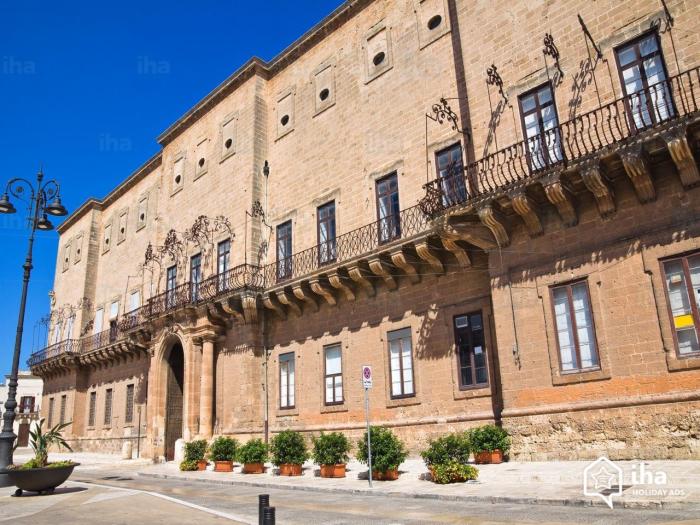
- Castle, which was the seat of the Imperiali princes from 1719.
- Archaeological Park
- Arch of Sant’Angelo, gateway to the historical center
Source: https://en.wikipedia.org/wiki/Manduria
Hereunder is the official site of the town of Manduria:
 VILLA EDINA - SAN PIETRO IN BEVAGNA
2 thoughts on “Manduria – the mother town of San Pietro in Bevagna”