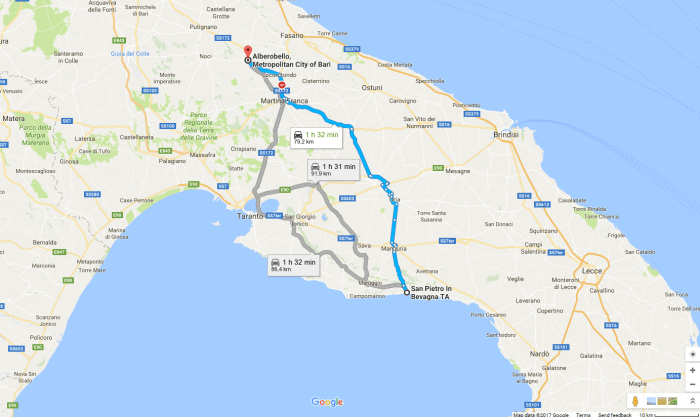
Puglia’s most striking and unique tourist attraction are the trulli. There is a “trulli district” around Alberobello (a UNESCO World Heritage site). But you can find many trulli scattered around in the Salento countryside including the San Pietro in Bevagna area, in the immediate neighbourhood of Villa Edina.


A trullo is a simple dry-stone-walled building with a domed roof topped by a cone. They are dotted around the green Valle d’Itria, and in Alberobello the town’s large clusters of white-washed trulli create an unusual and memorable scene. Alberobello (Italian: “beautiful tree”) is a small town in Salento with about ten thousand inhabitants.
Alberobello was first mentioned in the early 16th century when the first 40 families were granted land to farm in the area. The abundance of calcareous sedimentary material in the area lead to the building of houses with dry stone without the use of mortar. These houses were the first trulli which contributed to the expansion of the settlement. Building the houses of dry stone was a requirement of Count Giangirolamo II as in this way it was avoidable to pay taxes on them.
So, a trullo (plural, trulli) is a traditional Apulian dry stone hut with a conical roof. Trulli were generally constructed as temporary field shelters and storehouses or as permanent dwellings by small proprietors or agricultural workers. The golden age of trulli was the 19th century, especially its final decades marked by the quick development of wine growing.
The Italian term il trullo (from the Greek word τρούλος, cupola) refers to a house whose internal space is covered by a dry stone corbelled or keystone vault. Trullo is an italianized form of the dialectal term truddu used in a specific area of the Salentine peninsula (i.e. Lizzaio, Maruggio and Avetrana, in other words outside the Murgia dei Trulli proper) where it is the name of the local agricultural dry stone hut. A stonemason specializing in the building of trulli is a trullisto or trullaro in Italian.
In the countryside, trullo domes were built singly or in groups of up to five, or sometimes in large farmyard clusters of a dozen or two dozen, but never for the occupancy of more than a single rural family. Depending on the area, the building material used could be either hard limestone or calcareous tufa.
In Alberobello, the structural walls of a trullo are laid directly on the bedrock, after removal of the topsoil when necessary. Their width varies from 0.80 metres to 2.70. Their height (from ground level to where the vault starts) ranges from 1.60 metres to 2 metres. The stones needed for starting to build a trullo were provided by digging a cistern (cisterna), an absolute necessity in an area devoid of water. The cistern was capped with a lime-mortared barrel vault or dome which in many cases supported the floor of the house.
The trullo may take on a circular or a square plan. The circular trullo is mostly a temporary shelter for animals and their fodder, or for the peasant himself. The roofs are constructed in two skins: an inner skin of limestone, capped by a closing stone, and an outer skin of limestone slabs that are slightly tilted outwardly, ensuring that the structure is watertight. The roof stones can be taken away without compromising the stability of the rest.
A multi-room trullo house has many cones representing a room each. Along with its exterior wall, a trullo’s interior room and vault intrados were often rendered with lime plaster and whitewashed for protection against drafts.
The trulli used as dwellings all have an open fireplace complete with a flue (hidden in the masonry) and a stone-built chimney stack (rising high above the roof). Because of their design, trulli are difficult to heat: the walls are too thick and warm air will rise up the interior cone. The thick stone walls and dome of the trullo, pleasantly cool in the summer, tend to become unpleasantly cold during the winter months, condensing the moisture given off by cooking and breathing and making it difficult to feel warm even in front of the fire. The inhabitants simply leave the doors open during the day to keep the interior dry, and live more outdoors than inside.


Owing to the concentration of houses, trulli have few openings outside their doorway and a small aperture provided in the roof cone for ventilation. As a result, it can be quite dark inside. Some trullo houses have had their perimeter walls substantially raised so that their cones can be hidden from view, making the buildings look like ordinary houses.
There are many theories behind the origin of the design. One of the more popular theories is that due to high taxaion on property the people of Apulia built dry stone wall constructions so that they could be dismantled quickly when tax inspectors were in the area.
A Plan of the Territory of Mottala drawn by Donato Gallerano in 1704 reveals the existence of a nucleus of trulli in the midst of a large forest, making up the initial settlement of Arbore bello. The urban trulli in Alberobello date from the 18th, 19th and 20th centuries. The trulli settlements started being deserted in the second half of the 20th century. The rural trulli, on cheaper land, ceased to be built when the cost of labour began to rise in the twentieth century. The sheer expense of handling the hundreds of tons of stones necessary for a single house became prohibitive.


Recently a large number of trullo houses have been restored and converted into second homes or self-catering cottages. In 1999, rebuilding a trullo roof would cost about 1,500 euros; in 2009 the cost rose up to 15,000 euros. In late twentieth century, a local craftsman, Guido Antionetta, came up with the idea of buying up a few dozen abandoned trulli, he installed in them modern kitchenettes, a few pieces of wooden furniture and cast-iron bedframes to rent them out as mini apartments. In the Alberobello region, local residents who still live in trulli only do so because they cannot afford to move out or because they provide bed and board for tourists in their trulli.
 VILLA EDINA - SAN PIETRO IN BEVAGNA
One thought on “The Trulli”