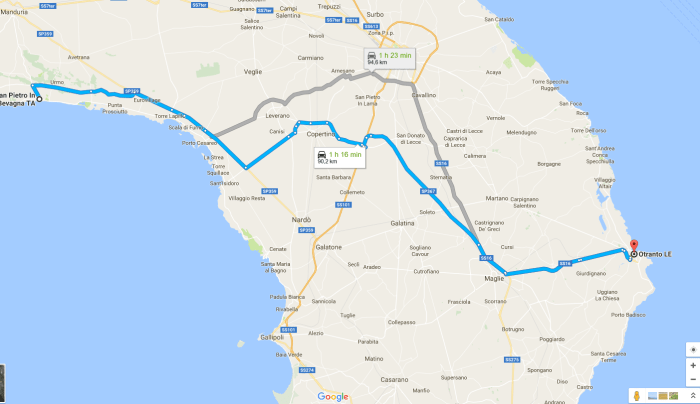
Otranto is some 80 minute drive from Villa Edina – and it’s worth a try. Otranto (Latin: Hydruntum) is a town in the province of Lecce, in a fertile region once famous for its breed of horses. Otranto has a warm Mediterranean climate and a nice beach in the center of the town.
It is located on the east coast of the Salento peninsula. The Strait of Otranto, to which the city gives its name, connects the Adriatic Sea with the Ioninan sea and separates Italy from Albania. Otranto’s harbour is small and has little trade.


The lighthouse Faro della Palascìa, at approximately 5 kilometres (3 miles) southeast of Otranto, marks the most easterly point of the Italian mainland.
About 50 kilometres south lies the promontory of Sant Maria di Leuca (so called since ancient times from its white cliffs, leukos being Greek for white), the southeastern extremity of Italy, the ancient Promontorium lapygium or Sallentinum. The district between this promontory and Otranto is thickly populated and very fertile.
Otranto occupies the site of the ancient Hydrus (in Greek: Ὑδροῦς) or Hydruntum (in Latin). Otranto was a town of Greek origin, which, in the wars of Pyrrhus and of Hannibal sided against Rome. In Roman times it was a city. As it is the nearest port to the eastern coast of the Adriatic Sea, it was perhaps more important than Brundisium (present Brindisi), under the Roman emperors as a point of embarkation for the East, as the distance to Apollonia was less than from Brundisium.
It remained in the hands of the Byzantine emperors until it was among the last cities of Apulia to surrender to the Norman Robert Guiscard in 1068, and then became part of the Principality of Taranto. In the Middle Ages the Jews had a school there.
In 1480, Mehmet the Conqueror sent an Ottoman fleet to invade Rome. This force reached the shores of Apulia on 28 July 1480 and the city was captured in two weeks on 11 August 1480. Some 800 citizens, known as the “Martyrs of Otranto,” were beheaded after refusing to convert to Islam. They were canonized by Pope Francis on 12 May 2013.
The main sights of Otranto:
- The Castello Aragonese (Castle), reinforced by Emperor Frederick II and rebuilt by Alphonso II of Naples in 1485–98. It has an irregular plan with five sides, with a moat running along the entire perimeter. In origin it had a single entrance, reachable through a draw-bridge. Towers include three cylindrical ones and a bastion called Punta di Diamante (“Diamond’s Head”). The entrance sports the coat of arms of Emperor Charles V.
- The Cathedral, consecrated in 1088, a work of Count Roger I adorned later (about 1163), by Bishop Jonathas, with a mosaic floor; it has a rose window and side portal of 1481. The interior, a basilica with nave and two aisles, contains columns said to come from a temple of Minerva and a fine mosaic pavement of 1166, with interesting representations of the months, Old Testament subjects and others. Bones and relics of the Martyrs of Otranto, who perished in the 15th-century siege surround the high altar. The church has a crypt supported by 42 marble columns. The same Count Roger also founded a Basilian monastery here, which, under Abbot Nicetas, became a place of study; its library was nearly all bought by Bessarion.
- The church of San Pietro, with Byzantine frescoes.
- The catacombs of Torre Pinta.
- Idro, a small river which the toponym Otranto stems from


Source: Wikipedia.
Official website of Otranto: http://www.comune.otranto.le.it/
 VILLA EDINA - SAN PIETRO IN BEVAGNA
One thought on “A trip to Otranto – A tip from Villa Edina”