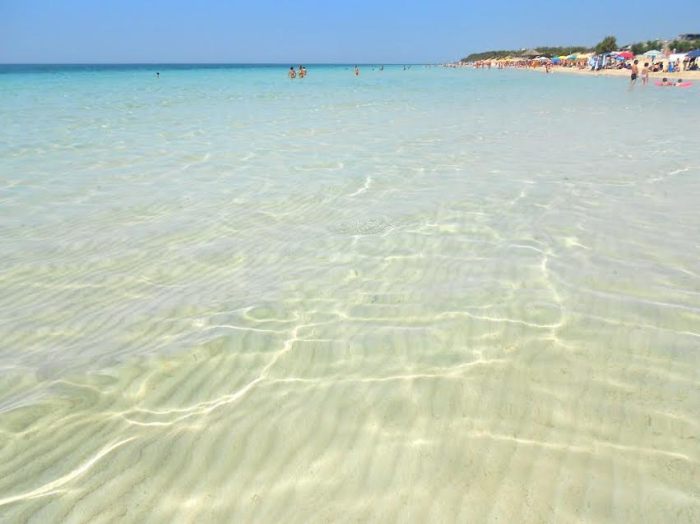
San Pietro in Bevagna (San Pietru Manduria in local dialect) is a seaside village on the Ionian coast of Salento in the township of Manduria, province of Taranto. In the summer the village is full of tourists (mostly locals) who enjoy seaside tourism at a reasonable price. San Pietro in Bevagna has a 5 kilometer long sandy coastline. This coastline is one of the most beautiful one in Italy and very highly rated by locals and by tourists alike and sometimes is referred to as the “Puglian Maldives”.
The village is located on the Ionian coast between Taranto and Gallipoli, some 10 km from the town of Manduria in southern Italy, Apulia (Puglia). The village’s tiny river is called Chidro, which is one of the few rivers in the Salento region. The village is divided into different neighborhoods: the central area, Specchiarica (to the east) and the Messapii Camp area to the west.
The origin of San Pietro in Bevagna is closely linked to the history of the Apostle St. Peter. The legend holds that during a sea voyage, struck by a bad storm St. Peter wrecked on the Ionian coast where now stands the beautiful church in the center of the village. Tired and thirsty, St. Peter walked past a freshwater well by which stood a statue of a pagan god (most probably Zeus). Seeing the sculpture he made the sign of the cross by which the statue was shattered and fell down. The people who witnessed the miracle converted to Christianity. The village started to be populated by people coming from afar to visit the sacred place where the apostle had performed this miracle act. The church (Church of the Rock, or Crypt Redeemer) that still lies at the center of the village is of mystical beauty.
In reality San Pietro in Bevagna is the beach village of Manduria with a busy summer season serviced by a lot of restaurants, cafes, shops, delis, hotels, apartments and villas for rent and a seasonal attraction park close to the beach. It offers a great variety of leisure and cultural activities. The village started to grow after WWII, especially after the seventies. In the seventies a lot of holiday homes were constructed without official permission which was later stopped by the authorities.
The symbol of the village is the church dedicated to St. Peter, leaning to a medieval watchtower. On the seabed near the beach, there are marble sarcophagi that are the remains of the cargo of a Roman ship sunk there in the third century A.D. The sarcophagi can be seen underwater by diving. The river Chidro reaches the sea on the beach of San Pietro in Bevagna, therefore tourists can swim in fresh water as well. The natural park around the river is called Riserva naturale Regionale “Foce del Chidro” (Regional natural reserve of the Chidro mouth).The Chidro River, only 350 meters long, is fed by underground springs, and flows into the sea through a channel formed naturally. This river and its immediate neighborhood host rare species. The river is popular with divers who dive to admire the vegetation. Also one can observe the phenomenon of “citri”, the bubbling of the sand, but the most peculiar phenomenon is the enormous jet of water coming out with considerable pressure from the source at 12 meters depth. According to the legend, the water of the Chidro healed Apostle Peter from leprosy.
San Pietro in Bevagna has a warm and temperate climate with a hot and sunny summer. The winter has a lot more rainfall than the summer. The average temperature of San Pietro in Bevagna is 16.9 °C (Köppen-Geiger climate classification), with July and August being the hottest months, with an average of 25 °C. The average sea temperature in these months is above 25 °C. The average annual rainfall is 534 mm; 16 mm in July, which is the driest month and 75 mm in November is the wettest. During the year the average monthly temperatures vary by 16.2 °C.
The economy of San Pietro in Bevagna is based on summer tourism. Tourism is mostly local but foreign tourism is also becoming more and more significant in the village. Due to the village’s important tourism incomes it has become one of the main economic resources of the municipality of Manduria. Around San Pietro in Bevagna there are major olive plantations and vineyards where the special local grape, called “primitivo” is cultivated. Primitivo is a variety of red grape whose ideal habitat is the red soils of Taranto Province where it is used to produce the wine “Primitivo di Manduria” Doc.
The transport company SITA SUD guarantees an urban public transport service between Manduria, Torre Borraco, San Pietro in Bevagna and Torre Colimena (bus line 4). Rail transport is ensured by the Manduria station, part of the Ferrovie del Sud Est circuit with connections to all locations served by the line.
SAN PIETRO IN BEVAGNA: ALLGEMEINE INFORMATIONEN
San Pietro in Bevagna (San Pietru Manduria im lokalen Dialekt) ist ein Küstendorf an der ionischen Küste des Salento in der Gemeinde Manduria, Provinz Taranto. Im Sommer ist das Dorf voller Touristen (meist Einheimische), die den Seetourismus zu einem vernünftigen Preis genießen. San Pietro in Bevagna hat eine 5 Kilometer lange freie Sandküste. Diese Küstenlinie ist eine der schönsten in Italien und sehr hoch bewertet von Einheimischen und ebenfalls von Touristen, und manchmal auch als “Puglischen Maldiven” bezeichnet.
Das Dorf liegt an der Ionischen Küste zwischen Taranto und Gallipoli, etwa 10 km von der Stadt Manduria entfernt, im Süden Italiens, in Apulien (Puglia). Der kleine Fluss des Dorfes heißt Chidro, er ist einer der wenigen Flüsse im Salento. Das Dorf ist in verschiedene Nachbarschaften geteilt: der zentrale Bereich (wo sich die Kirche findet), Specchiarica (nach Osten) und der Messapi Lager im Westen.
San Pietro in Bevagna ist das Stranddorf Manduria mit einer geschäftigen Sommersaison, die von vielen Restaurants, Cafes, Geschäften, Delis, Hotels, Apartments und Villen zur Miete und einem saisonalen Attraktionspark in der Nähe des Strandes serviert wird. Es bietet eine Vielzahl von Freizeit- und Kulturaktivitäten. Das Dorf begann nach dem Zweiten Weltkrieg zu wachsen, besonders nach den siebziger Jahren. In den siebziger Jahren wurden viele Ferienhäuser ohne offizielle Erlaubnis gebaut, die später von den Behörden gestoppt wurde.
Das Symbol des Dorfes ist die Kirche, die dem hl. Petrus gewidmet ist und sich an einen mittelalterlichen Wachtturm lehnt. Auf dem Meeresboden in der Nähe des Strandes gibt es Marmorsarkophage, die die Überreste der Ladung eines römischen Schiffes sind, das dort im dritten Jahrhundert abgesenkt wurde. Die Sarkophage kann unter Wasser durch Tauchen gesehen werden. Der Fluss Chidro erreicht das Meer am Strand von San Pietro in Bevagna, wo Touristen auch im Süßwasser schwimmen können. Der Naturpark rund um den Fluss heißt Riserva Naturale Regionale “Foce del Chidro” (Regionales Naturschutzgebiet des Chidro-Mundes). Der Chidro-Fluss, der nur 350 Meter lang ist, wird von unterirdischen Quellen gespeist und fließt durch einen Kanal in das Meer natürlich. Dieser Fluss und seine unmittelbare Nachbarschaft Gastgeber seltene Arten. Der Fluss ist bei Tauchern beliebt, die die Vegetation bewundern. Man kann auch das Phänomen von “citri”, die Blasenbildung des Sandes, beobachten, aber das eigenartigste Phänomen ist der enorme Wasserstrahl, der mit beträchtlichem Druck aus der Quelle in 12 Meter Tiefe herauskommt. Nach der Legende heilte das Wasser des Chidro Apostel Petrus von Lepra.
San Pietro in Bevagna hat ein warmes und gemäßigtes Klima mit einem heißen und sonnigen Sommer. Der Winter hat viel mehr Niederschlag als der Sommer. Die Durchschnittstemperatur von San Pietro in Bevagna beträgt 16,9 ° C (Köppen-Geiger Klimaklassifikation), wobei Juli und August die heißesten Monate mit durchschnittlich 25 ° C sind. Die durchschnittliche Meerestemperatur in diesen Monaten liegt über 25 ° C. Der durchschnittliche jährliche Niederschlag beträgt 534 mm; 16 mm im Juli, das ist der trockenste Monat und 75 mm im November, der der feuchteste ist. Im Laufe des Jahres variieren die durchschnittlichen monatlichen Temperaturen um 16,2 ° C.
Die Wirtschaft von San Pietro in Bevagna basiert sich auf Sommertourismus. Tourismus ist meist lokal, aber auch der ausländische Tourismus wird im Dorf immer wichtiger. Aufgrund der bedeutenden touristischen Einkommen des Dorfes hat es sich zu einer der wichtigsten wirtschaftlichen Ressourcen der Gemeinde Manduria entwickelt. Um San Pietro in Bevagna gibt es große Olivenplantagen und Weinberge, wo die besondere lokale Traube, der “Primitivo” angebaut wird. Primitivo ist eine Vielzahl von roten Trauben, deren idealer Lebensraum die roten Böden der Provinz Taranto sind, wo es verwendet wird, um den Wein “Primitivo di Manduria” Doc zu erzeugen.
Das Transportunternehmen SITA SUD garantiert einen öffentlichen Nahverkehr zwischen Manduria, Torre Borraco, San Pietro in Bevagna und Torre Colimena (Buslinie 4). Der Schienenverkehr wird durch die Manduria-Station, einen Teil der Ferrovie del Sud Est-Strecke mit Verbindungen zu allen Orten, die von der Linie bedient werden, gewährleistet.
 VILLA EDINA - SAN PIETRO IN BEVAGNA